Return to Player: The Number That Shapes Every Session
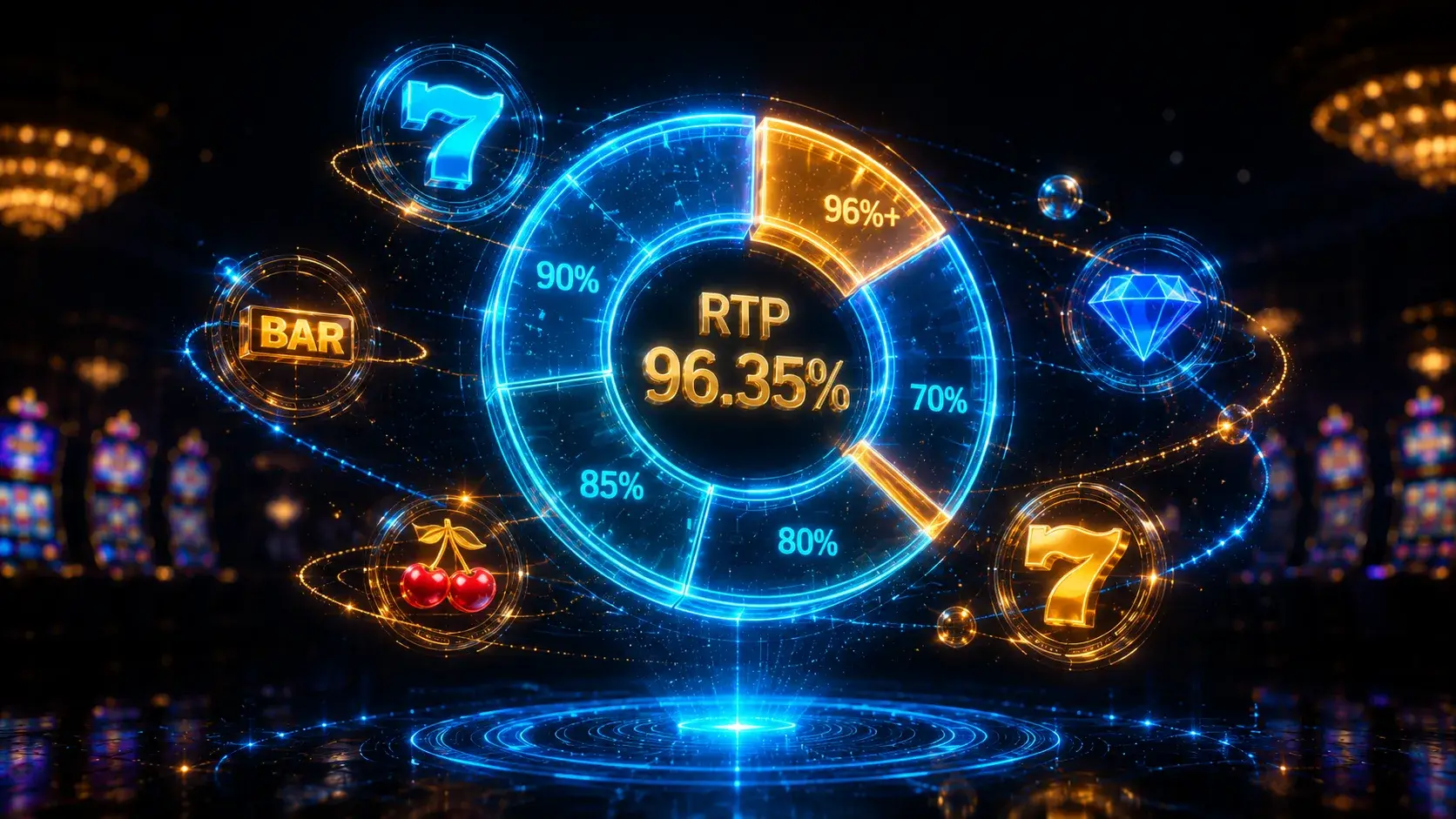
Return to Player, universally shortened to RTP, is the theoretical percentage of wagered coin volume a slot returns to its players over an enormous simulated horizon — usually one hundred million spins or more inside the studio's internal certification harness. A slot advertised at 96.50% RTP is one where, across that entire theoretical horizon, ninety-six dollars and fifty cents of every hundred wagered eventually cycle back through the win channel. The remaining three dollars and fifty cents represent the mathematical house edge, an inescapable structural feature that funds jackpot pools, tournament prize purses, and the operational overhead of the sweepstakes platform. Every certified title running on the SpinBlitz slot library is signed off by third-party auditors such as iTech Labs, GLI, or eCOGRA, meaning the posted percentage is not a marketing claim but a verifiable mathematical property of the reel weights baked into the game file.
The critical caveat that separates informed sweepstakes players from casual spinners is horizon length. RTP is a limit — a value the game asymptotically approaches only after millions of spins. Any single session, even one that runs to a thousand spins, is nothing more than a rounding error against that limit. Two players spinning the same 96.50% title for an hour can walk away with dramatically different balances, and neither result contradicts the posted return. The math simply has not had enough sample size to express itself. This is why we counsel every new participant reaching the SpinBlitz platform through the new account signup flow to internalize RTP as a long-arc contract, not a short-arc guarantee.
Because RTP describes only the return channel, it says nothing about the shape of that return. Two slots publishing an identical 96.50% figure can distribute wins in completely different rhythms — one might drip tiny credits on almost every spin while the other stays silent for eighty spins before erupting into a five-hundred-times multiplier. That distribution property is called volatility, and it is arguably a more pragmatic metric for session planning than RTP itself. A high-volatility engine is not stingier over the long horizon; it simply concentrates the same theoretical return into rarer, larger bursts, and that concentration profile dictates whether your Gold Coin stack will survive a fifteen-minute lunch break or evaporate before you refill your coffee.
Volatility Tiers Explained From Low To Extreme
The sweepstakes industry has never fully standardised its volatility scale, but a four-tier taxonomy has emerged organically across the largest studios. Low-volatility titles publish hit frequencies above thirty percent and top-line multipliers rarely exceeding two hundred times the stake. They function as bankroll preservation machines — sessions are long, the balance oscillates gently, and the emotional experience is closer to a slow burn than a lottery. Medium-volatility engines pull the hit frequency down into the low twenties and lift the ceiling into the seven-hundred-to-two-thousand range. They are the workhorses of the modern lobby and represent the balanced default that most Canadian sweepstakes players actually enjoy over multi-hour play blocks.
High and extreme volatility titles are a different animal entirely. Hit frequency drops toward or below the twenty-percent line, and top-line multipliers explode from five thousand times all the way up to fifty thousand times the wager. These are the boards that generate viral clips and screenshot bragging rights, but they also demand disciplined coin management. A thousand-spin session on an extreme engine can absorb ninety percent of your Gold Coin stack before delivering the single feature that redeems the entire block. Newcomers unfamiliar with variance mathematics routinely misread this pattern as a broken or rigged game when, in fact, they are simply experiencing the low end of a highly kurtotic distribution.

| Volatility Tier | Typical Hit Frequency | Max Multiplier Ceiling | Recommended Session Length | Ideal Player Profile |
|---|---|---|---|---|
| Low (1/5) | 32%–45% | 150x – 500x | 60+ minutes | Bankroll preservers, grind sessions |
| Medium (2–3/5) | 22%–30% | 700x – 2,500x | 30–60 minutes | Balanced recreational play |
| High (4/5) | 18%–22% | 5,000x – 15,000x | 15–30 minutes | Bonus hunters, feature seekers |
| Extreme (5/5) | 16%–20% | 20,000x – 50,000x+ | Short bursts only | High-conviction thrill chasers |
Hit Frequency, Win Magnitude, and Why They Diverge
The most under-appreciated metric on any modern slot data sheet is hit frequency. Where RTP describes total value returned, hit frequency describes the percentage of spins that produce any credit at all, no matter how microscopic. A slot can post a stellar 96.80% RTP alongside a punishing 18% hit frequency — the mathematics balance because those rare hits carry outsized multipliers. Conversely, a low-variance classic can hit on 42% of spins but deliver an average win worth only 0.9x the stake, producing the same headline RTP through the opposite behavioural profile. Neither is objectively superior; they simply serve different emotional and strategic goals.
Once you accept that hit frequency and RTP are orthogonal properties, session planning becomes a matter of matching the reel behaviour to your coin cadence. If you have thirty minutes and a small stack, a low-variance engine buys you playtime and a smoother curve, even though the theoretical peak is capped. If you have a modest stack and a genuine appetite for a screenshot moment, a high-variance engine offers a shorter, sharper session where a single feature can more than triple your entry balance. The trap most inexperienced players fall into is chasing the ceiling of a high-variance title with a bankroll appropriate only for low variance, then abandoning ship right before the reels would have delivered.
Studio Signatures and Their Volatility Fingerprints
Each major B2B studio distinguishes itself through a distinctive volatility fingerprint. Pragmatic Play, the sector heavyweight, ships the vast majority of its catalogue at high volatility with an aggressive bonus buy layer that funnels the bulk of RTP through the free spins module. Hacksaw Gaming has doubled down on extreme volatility with lean base games and monstrous multiplier ceilings that flirt with fifty-thousand-times the stake. Relax Gaming, publisher of the Money Train series, occupies a similar extreme tier but layers narrative micro-features that make base-game dead spins feel less punishing. Playson and Booongo tune closer to the medium band, prioritising rhythm and long sessions over ceiling-chasing.
Understanding these signatures allows you to walk into an unfamiliar title with realistic expectations. Loading a fresh Hacksaw release, you should not expect a 40% hit frequency; the studio's DNA is skewed toward silence-then-eruption. Loading a Playson jackpot title, you should not expect a 30,000x screenshot moment; that is not what the studio builds. If you are new to slot classification, the fastest way to internalise these fingerprints is to visit the full sweepstakes catalogue, filter by studio, and run twenty spins on the demo build before committing any Sweepstakes Coin balance.

| Studio | Median RTP | Default Volatility | Max Win Ceiling | Bonus-Buy Support |
|---|---|---|---|---|
| Pragmatic Play | 96.50% | High | 5,000x – 12,000x | Broad (majority of releases) |
| Hacksaw Gaming | 96.30% | Extreme | 25,000x – 50,000x | Universal |
| Relax Gaming | 96.65% | High – Extreme | 20,000x – 50,000x | Universal on flagships |
| Playson | 96.15% | Medium | 1,500x – 3,000x | Selective |
| NoLimit City | 96.20% | Extreme | 25,000x – 50,000x | xBet-tier buy modules |
| Push Gaming | 96.55% | High | 10,000x – 20,000x | Broad |
Bankroll Pacing: Matching Coin Stacks to Variance
Once you have picked a title matching your appetite, the second lever is stake sizing. The professional heuristic — refined over decades of table-game bankroll theory and cleanly transferable to Gold Coin economies — is to size your per-spin wager so that a losing sequence equal to the game's expected dry-streak length still leaves you with at least three feature triggers of remaining balance. On a medium-variance engine that translates to roughly one hundred and fifty base bets. On a high-variance engine you should hold four hundred base bets, and on an extreme-variance monster you should ideally sit on eight hundred base bets or more before you press spin. Under-bankrolled sessions do not lose to bad luck; they lose to insufficient sample size to reach the paying part of the distribution curve.
The most common bankroll mistake is scaling stake to emotion rather than variance. A player on a five-hundred coin stack who loads an extreme-variance title and bets ten coins per spin has fifty base bets — objectively insufficient to survive the average dry stretch on that class of slot. The fix is not more aggressive spinning; the fix is either dropping the stake to one coin per spin or migrating to a medium-variance title where fifty base bets is a viable session. This kind of calibration is what separates recreational churn from disciplined enjoyment. Players who route through the daily coin promotion drops can steadily replenish their base bankroll and lift themselves into the sample-size band appropriate for the games they actually enjoy.
| Volatility Tier | Minimum Base Bets | Comfortable Base Bets | Example Stake | Example Bankroll |
|---|---|---|---|---|
| Low | 60 | 120 | 1 GC | 120 GC |
| Medium | 100 | 200 | 2 GC | 400 GC |
| High | 250 | 400 | 1 GC | 400 GC |
| Extreme | 500 | 800 | 0.5 GC | 400 GC |
Bonus Rounds, Buy Features, and RTP Redistribution
Modern slots concentrate the bulk of their RTP inside the bonus round. In the extreme-volatility segment, upwards of seventy-five percent of the theoretical return is delivered during free spins, cascading re-triggers, or unlocked jackpot pickers. Base game spins effectively function as ticket-purchases that grant probabilistic access to the bonus round. The Buy Feature module, popularised by Big Time Gaming and now industry standard, lets a player skip the ticket-purchase phase entirely by paying a lump multiplier (typically 75x to 120x the stake) to immediately trigger the bonus. RTP inside a purchased bonus is typically bumped upward by a small margin — often 0.3 to 0.6 percentage points — because the studio no longer has to underwrite the drop chance.
The strategic implication is significant. If a title publishes a base RTP of 96.30% and a bonus-buy RTP of 96.85%, the buy-in is mathematically favourable in the long run — provided you can absorb the variance of a lump-sum wager. The trap is emotional: a bonus-buy that ships a 5x return feels like a loss even though the same spin sequence delivered inside a base-game trigger would have felt like a victory. Buy features suit players with defined per-session coin allocation and no residual attachment to any individual bonus outcome. If either condition is missing, base-game triggers remain the emotionally safer path even at slightly lower posted RTP.
For a broader understanding of how these mechanical variations intersect with the sweepstakes framework you're playing under, cross-reference this material with the Canadian sweepstakes regulation walk-through. Volatility and RTP shape what happens on the reel; the sweepstakes ruleset shapes what happens to the credits after they land. Both perspectives combined leave you with genuinely durable strategic literacy.
Organic Base-Game Trigger
- Zero up-front premium
- Session duration extends naturally between features
- Emotional payoff amplified by anticipation
- RTP typically 0.3–0.6 pp lower than the bought variant
- Best fit for long recreational sessions
Bonus Buy Trigger
- Guaranteed feature access — no dry spins
- Session compressed into single lump wager
- RTP typically 0.3–0.6 pp higher than the organic path
- Requires disciplined loss tolerance on each buy
- Best fit for defined per-session coin allocation
Frequently Asked Questions
Is a higher RTP always the better pick? On a purely mathematical basis, yes — over the theoretical horizon, 97.10% returns more coin than 96.20%. In practical session terms the delta is negligible because a single Canadian sweepstakes play block will never reach the sample size where that 0.9 percentage-point gap materialises. Choose by volatility fit first, RTP second.
Can I identify volatility without playing? Most studios now publish an official volatility rating on the info panel of every slot. Where they do not, community aggregator sites and the SpinBlitz sweepstakes home lobby catalogue publish crowd-sourced ratings that generally agree within one tier.
Do sweepstakes titles have different RTP than real-money versions? No. Every certified game on the platform runs identical math tables to its real-money sibling, because the certification process regulates the game file itself, not the currency it is played with. The economy layer is different; the reel math is identical.